Who is Myopia.Care for?
Our platform is specifically designed for parents, affected children, and eye care specialists. Myopia.Care was founded to educate parents and optimally support professionals in their fight against the progression of nearsightedness (myopia) in children. Together, we protect the eye health of the next generation.
Our Interactive Analysis Curves
Myopia.Care offers freely accessible tools to visually assess axial eye length and the expected progression [2]. All four curves can be used free of charge, with no need to enter or store any personal contact information.
1. MyAppia
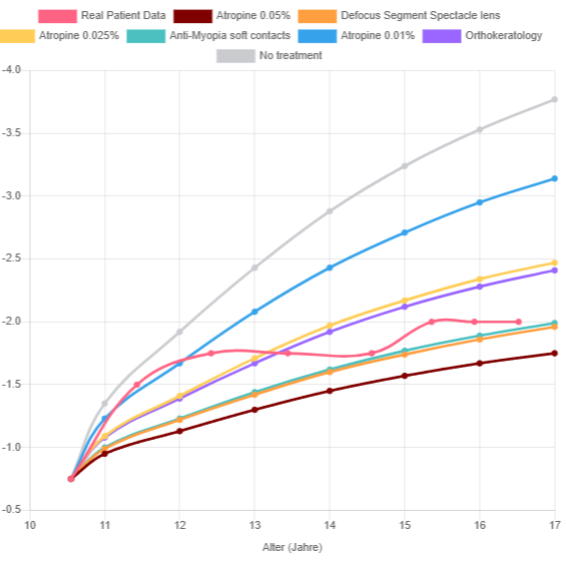
Myopia progression forecast: This curve predicts the expected development of nearsightedness up to age 17, based on study data and individual risk [3]. Compare the expected course without treatment directly with the calculated effects of various treatment options [4].
2. Growth Curve
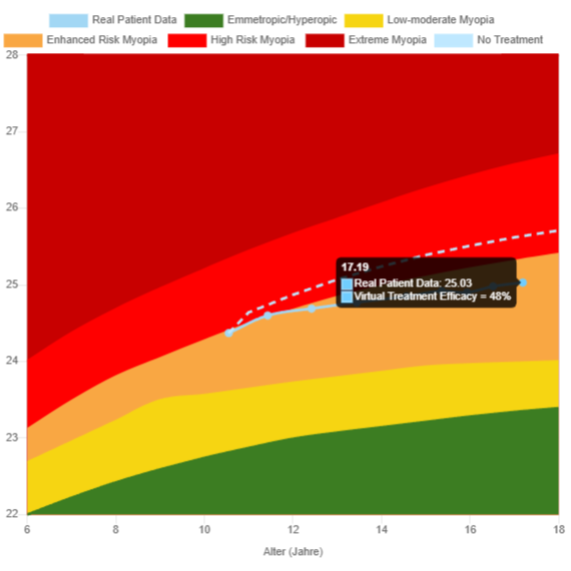
Axial length risk analysis: This shows the measured axial length of the eye in relation to age [5,6]. Thanks to an intuitive color-coded system (traffic light system), you immediately see the risk classification of the axial length, which significantly simplifies the decision on when to start treatment and which therapy strategy to choose [1].
3. Annual Growth
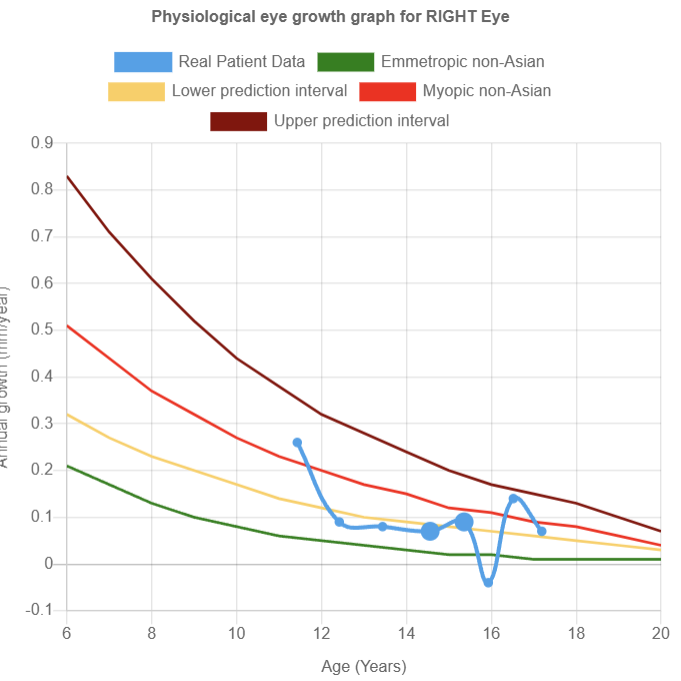
Assessment of treatment success: This graph shows the current treatment outcome. It compares the actual annual eye growth since the last measurement directly with the age-appropriate physiological (healthy) growth as well as the potential untreated myopic growth [7,8,9].
4. MiGeL Curve (Enhanced Risk Myopia)
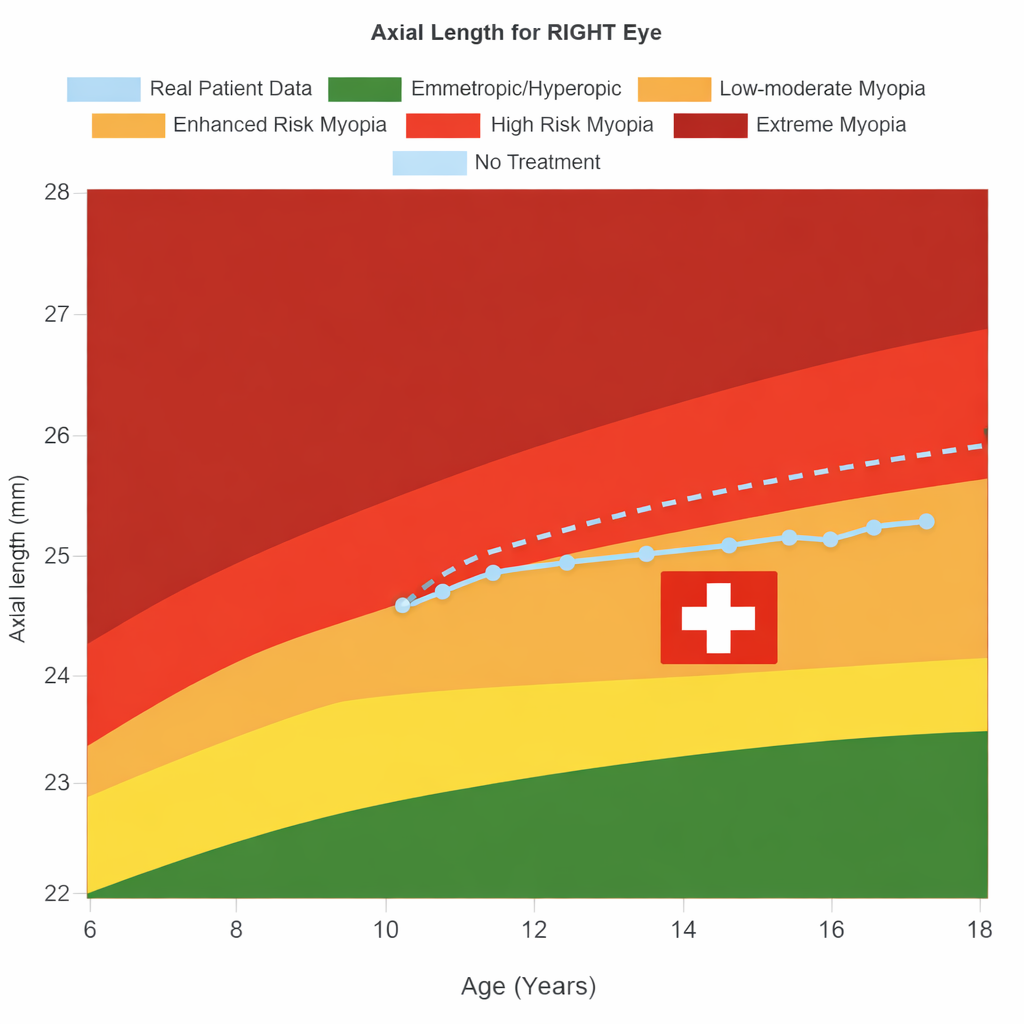
Assessment of myopia limitation: The SOG-recommended MiGeL curve for assessing high myopia for myopia limitation purposes is integrated into the growth curve starting from ERM [10]. This can be used to check whether a possible claim to MiGeL reimbursement exists [11].
Find an Eye Care Specialist Near You
For sound advice and treatment, you should always consult a specialist. Visit our specialist finder to locate accredited eye care specialists for myopia management near you.
Go to Specialist Finder
Are you an eye care specialist and want to become part of the Myopia.Care community?
Register as a Myopia.Care expert and use the Myopia.Care website even more efficiently in myopia management consultations.
More Information Register
Disclaimer
Myopia.Care provides information about your child's nearsightedness.
For advice and treatment of nearsightedness, you should always consult an eye care specialist (ophthalmologist, orthoptist, optometrist, or optician) who can perform the necessary tests and advise you accordingly. Our efforts to keep this questionnaire and the websites up to date with the latest myopia research make no claim to completeness, and we cannot guarantee the timeliness, accuracy, or balance of the information presented. The content of the website and the advice you receive from us do not constitute recommendations or endorsements of the products mentioned. The application in no way replaces professional advice from an eye care specialist and must not be used as a basis for independent diagnosis or for starting, changing, or discontinuing treatment for nearsightedness.
For legal reasons, the minimum age for using the questionnaire is 16 years. However, the questionnaire may be completed for children from age 6 together with a parent or legal guardian.
We take your privacy very seriously and protect your data as much as possible. To this end, we have made special adjustments to the database. We do not need your contact information for our service, and it can be deleted from the database by you or by the eye care specialist.
Further information at Privacy Policy
Sources:
- World Health Organization (WHO): Report of the Joint World Health Organization–Brien Holden Vision Institute Global Scientific Meeting on Myopia. University of New South Wales, Sydney, Australia 16–18 March 2016. Available at myopiainstitute.org
- Article in Review of Myopia Management, 7/9/2026: reviewofmm.com
- Zadnik K, Mutti DO, Mitchell GL, Jones LA, Burr D, Moeschberger ML. Normal eye growth in emmetropic schoolchildren. Optom Vis Sci. 2004 Nov;81(11):819-28. doi: 10.1097/01.opx.0000145028.53923.67. PMID: 15545807.
- Mark A. Bullimore, Kathryn J. Saunders, Rigmor C. Baraas, et al. IMI—Interventions for Controlling Myopia Onset and Progression 2025. Invest. Ophthalmol. Vis. Sci. 2025;66(12):39. doi.org/10.1167/iovs.66.12.39
- Sanz Diez P, Yang LH, Lu MX, et al. Growth curves of myopia-related parameters to clinically monitor the refractive development in Chinese schoolchildren. Graefes Arch Clin Exp Ophthalmol. 2019 May;257(5):1045-1053.
- Tideman JWL, Polling JR, Vingerling JR, et al. Axial length growth and the risk of developing myopia in European children. Acta Ophthalmol. 2018 May;96(3):301-309.
- Brennan NA, Shamp W, Maynes E, et al. Influence of age and race on axial elongation in myopic children: A systematic review and meta-regression. Optom Vis Sci 2024;101:497-507.
- Yii FS. Emmetropic eye growth in East Asians and non-East Asians. Ophthalmic Physiol Opt 2023;43:1412-8.
- Data provided courtesy of Dr. Mark Bullimore, bullers2020.com
- MiGeL Limitations as well as the guideline of the SOG-SSO Strabismus Working Group: sog-sso.ch
- MiGeL position no. 25.02.04.00.1 for myopia management, page 15: bag.admin.ch

 English
 Czech
Czech Deutsch
 Español
 Français
 Hebrew
 Italiano
 Nederlands
 Norsk
Norsk Polski
 Português
 România
 Русский
 中国
中国 한국의
한국의